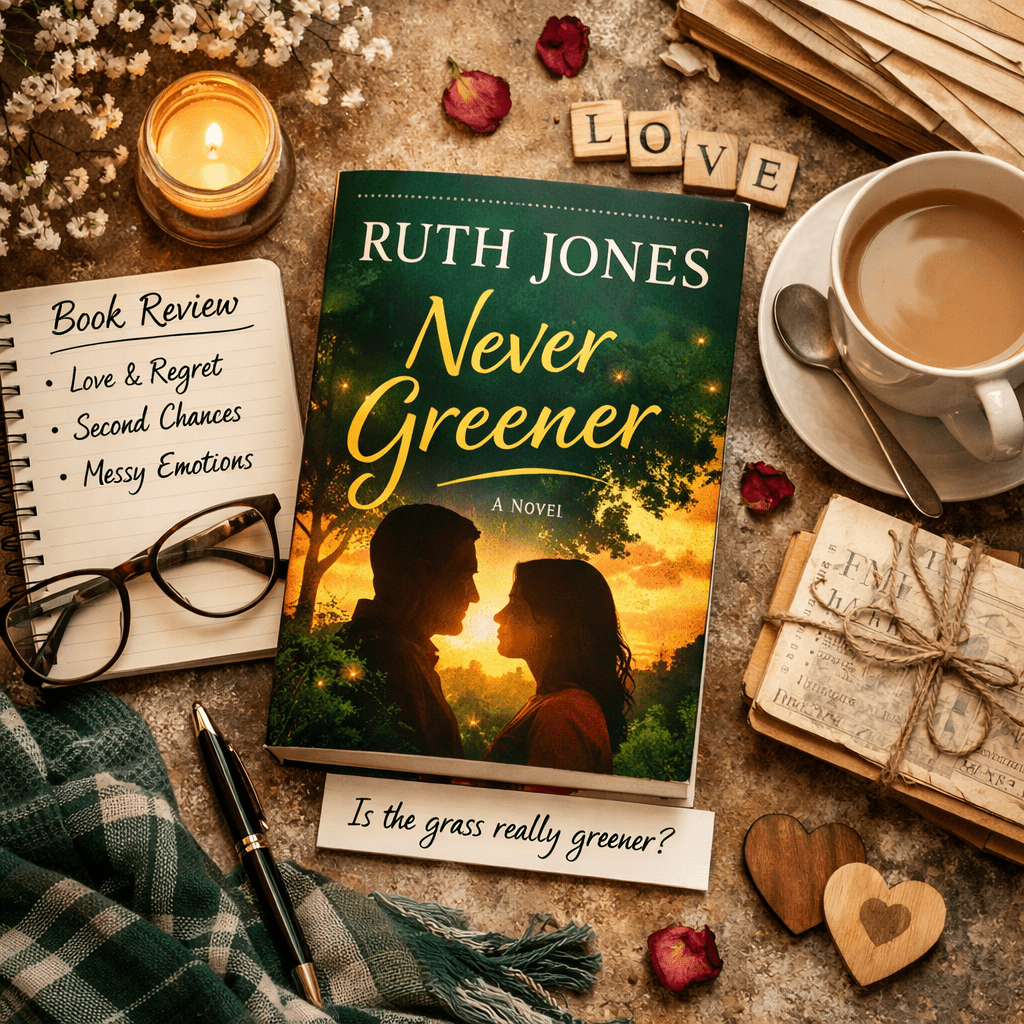
Rating: 3.5 / 5 stars (overall mixed but compelling in its own messy way)
If Ruth Jones’s name makes you think of Gavin & Stacey or Stella, you’re not alone — and your expectations likely bring a blend of warmth, wit, and sharply observed humanity. But Never Greener, her 2018 debut novel, is not a comedy with a neat laugh track. It’s a big, emotional, sometimes uncomfortable story about love, regret, and the way our choices echo through time.
🧠 The Premise — What This Story Is Really About
The book opens with a moment that sets the tone — Callum, a happily married schoolteacher, meets 22-year-old Kate, an aspiring actress, and within hours they’re embarking on an affair. This isn’t a flash in the pan; it’s a passionate, devastating entanglement that haunts them — and the people in their lives — for nearly two decades.
Seventeen years later:
Kate has become a successful London actress, married to Matt with a daughter. Callum, now older, still has a family and a life in Edinburgh. Then they bump into each other again — and sparks fly, like embers pressed back into flame.
At its heart, Never Greener asks: Is the grass really ever greener on the other side? Or are we just haunted by what might have happened? That question is a slow burn throughout the whole book.
🧍♀️ Characters — Flawed, Real, Polarizing
One of the most fascinating things about this novel is how differently readers react to the characters — maybe more than almost any book I’ve read recently.
Kate
She’s not your typical “heroine.”
In her youth, she’s reckless, seductive, and selfish. In later life, she’s successful but still insecure and impulsive. Some readers find her compelling and real; others find her hard to like — even dislike intensely because of her choices and lack of self-awareness.
Callum
He’s the classic “good guy” with a complicated weakness.
Happy in his marriage, yet unable to resist Kate — and that contradiction makes him frustrating and magnetic at the same time.
Matt & Belinda
Often the emotional anchors.
Kate’s husband Matt is steady, patient, and wounded by betrayal. Belinda, Callum’s wife, is compassionate yet quietly strong. Many readers love these characters more than the protagonists because they feel like real people navigating real hurt.
Hetty
A standout supporting role — funny, loyal, lovable, and deeply human. She brings levity and heart when the main story gets heavy.
✍️ Style & Structure — A Story Like a TV Script?
Jones is a screenwriter first, and it shows. The book often feels cinematic — scenes unfold visually, dialogue comes alive, and there’s a lot of action without long internal monologues. For some readers, that’s brilliant; for others, it’s frustratingly shallow.
The timeline jumps back and forth — 1985 to 2002 — giving you flashes of the past and present. That structure keeps things moving but sometimes sacrifices depth for momentum.
Overall, if you’re coming in expecting tightly wound literary prose, you might be underwhelmed. But if you love a story that feels visual and dynamic, this style can be really engaging.
❤️ Themes — Love, Regret, Second Chances, and Consequence
This book doesn’t sugarcoat anything. It’s messy. It’s human. It’s not about perfect relationships — it’s about conflicted people making conflicted choices.
Some of the big themes include:
Second chances — should we take them… or not? The price of desire — both emotional and ethical. The ripple effects on loved ones — especially people like Matt and Belinda, who often get the short end of the emotional stick.
There’s tension, passion, sadness, humour, and a kind of poignancy that keeps you thinking long after you finish the last page.
👍 For Whom This Book Works
✨ Great if you want:
Real, messy characters rather than fairy-tale romance. A story that sticks with you emotionally. Multiple viewpoints and a broad-canvas life drama. Wit and heart alongside heavier themes.
👎 Maybe skip if you want:
Likeable protagonists. A light, feel-good scrap of escapist romance. Tight narrative structure with deep interiority from a single POV.
🪩 Final Thoughts
Never Greener isn’t perfect — and that’s part of its charm. It’s bold, messy, sometimes infuriating, and unapologetically human. Not every choice feels justified, not every character is likeable, and the structure occasionally feels loose — but the story gives you a full emotional workout. You’ll laugh. You’ll cringe. You’ll wince. And you’ll probably think about it long after you put it down.
If you enjoy books that make you feel — even when you disagree with what you’re reading — this is one worth exploring.
Would you like a spoiler-free summary of the ending too, or a comparison with Ruth Jones’s other novels like Us Three or Love Untold?


 Chapters on Wheelz
Leave a comment