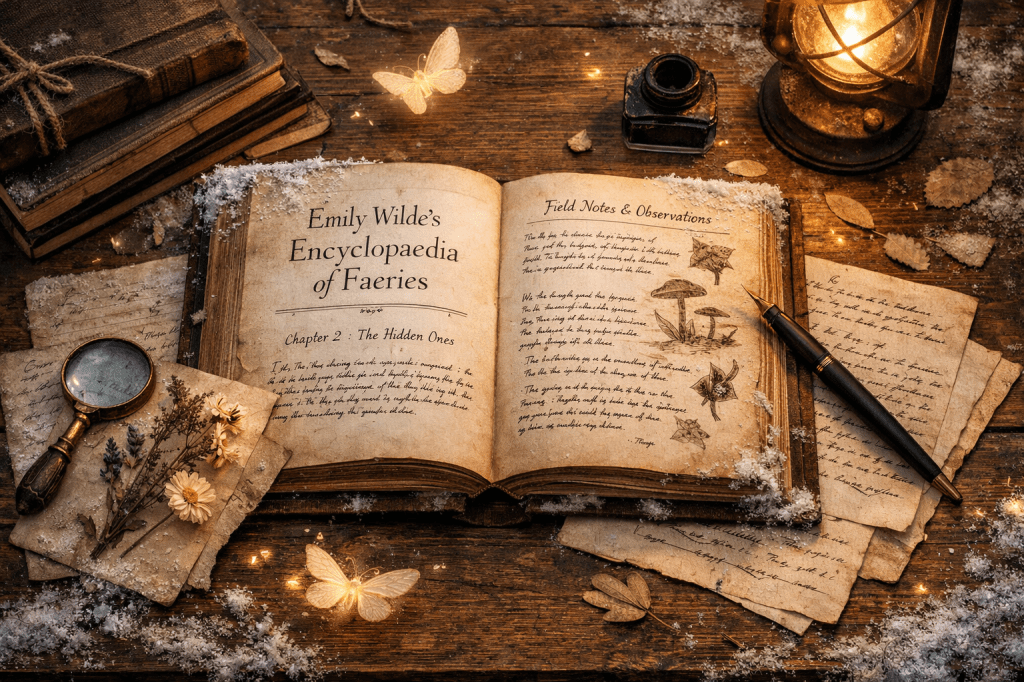
This may sound silly, but when I first heard about Emily Wilde’s Encyclopaedia of Faeries, I genuinely thought it was a real book. An actual academic encyclopaedia. The kind you’d expect to find tucked away in a quiet library, written by someone far more interested in folklore than in people.
It turns out, of course, that it isn’t real — it’s a fantasy novel by Heather Fawcett. And honestly, the fact I believed it was real for a moment says a lot about how convincing the concept and world-building are.
The story is told through Emily Wilde’s journal entries, notes, and observations, which gives the whole book a very scholarly, research-heavy feel. Emily herself is clever, blunt, socially awkward, and far more comfortable studying faeries than interacting with other humans. In many ways, she feels like someone who could genuinely exist, which adds to the realism of the book.
The folklore is one of the strongest parts. The faeries aren’t romanticised or overly whimsical — they’re strange, unsettling, and rooted in traditional myth. The academic tone, footnotes, and careful observations make the world feel thoughtfully built and well researched.
Wendell Bambleby is another highlight. His charm and chaos balance Emily’s seriousness nicely, and their dynamic brings warmth and humour to an otherwise very reserved, quiet story.
However — and this is where honesty matters — despite all of that, the book didn’t fully work for me.
Realistically, I would give Emily Wilde’s Encyclopaedia of Faeries a 2½-star rating out of five.
Not because it’s badly written — it isn’t at all — but because I found myself admiring it more than enjoying it. The pacing felt slow, and I struggled to feel emotionally invested. I kept waiting for a moment where everything would click, and it just never quite did.
Emily is an interesting protagonist, but I personally found it hard to connect with her on a deeper level. The cosy, academic, wintry atmosphere will absolutely be perfect for some readers, but I wanted a bit more momentum and emotional payoff than I got.
I completely understand why this book has such a loyal fanbase, and I can clearly see the care and intelligence behind it. It just didn’t fully land for me — and that’s okay. Sometimes a book can be clever, original, and well crafted, and still not be the right fit.
And yes, I still think it’s impressive that it convinced me the encyclopaedia might actually exist. If nothing else, that’s a testament to Heather Fawcett’s world-building.
Final rating: ⭐⭐½ out of 5


 Chapters on Wheelz
Leave a comment