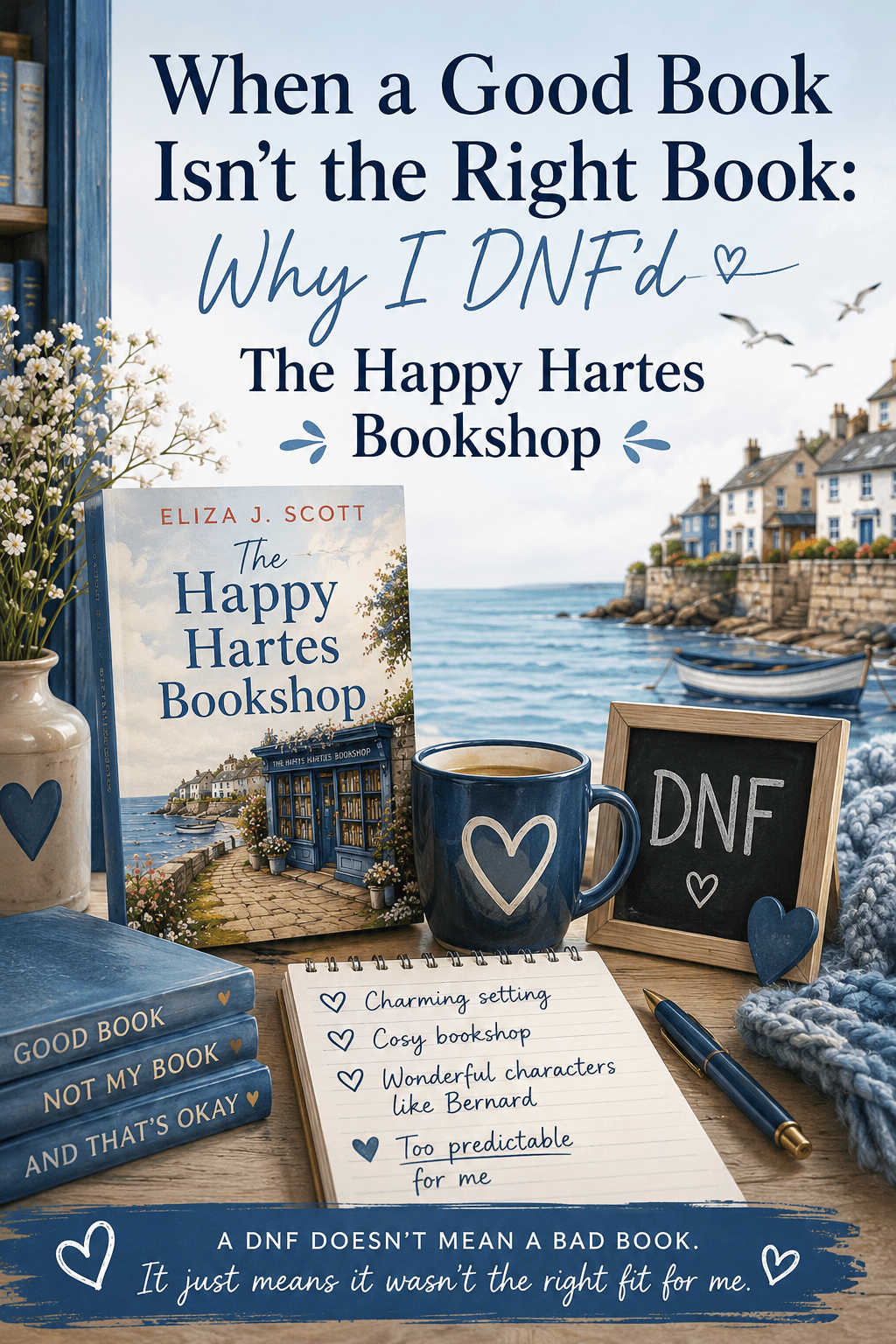
DNFs are never something I enjoy writing about, especially when there are parts of a book that I genuinely like. However, I also believe in being honest about my reading experience, and unfortunately The Happy Hartes Bookshop wasn’t the right fit for me.
Let me start with the positives.
The setting was lovely. Micklewick Bay felt like a charming North Yorkshire-inspired seaside town filled with history, community spirit, and memorable local characters. The independent bookshop itself was cosy and welcoming, and I could easily picture myself wandering through its shelves.
One of the biggest strengths of the book was Bernard Harte. He quickly became my favourite character. Beneath his matchmaking schemes and complete lack of subtlety was a man still grieving the loss of his wife, Dina. Some of the quieter moments exploring his grief were genuinely touching and gave the story emotional depth.
I also loved learning about Florrie’s connection to the bookshop. Discovering that she had loved the shop since childhood, that it was where her love of books first began, and that the Hartes had treated her like an unofficial granddaughter added warmth and heart to the story. The moment when six-year-old Florrie described the shop as something that “made her heart happy” was one of my favourite scenes.
So why did I decide to stop reading?
Quite simply, I found myself predicting almost every major development before it happened.
As I continued reading, I realised I wasn’t being surprised by the story. Instead, I was often waiting for the characters to catch up with conclusions I had already reached. While some readers enjoy knowing exactly where a story is heading, I personally enjoy books that keep me guessing a little more.
This isn’t a criticism of readers who love cosy fiction. In fact, I can completely understand why many people would enjoy this book. It offers a comforting setting, warm community relationships, and characters that are easy to spend time with.
For me, though, the predictability became impossible to ignore. Once I realised I was more interested in seeing whether my predictions would be confirmed than discovering what happened next, I knew it was time to move on to another book.
That’s the thing about reading: sometimes a book can be well written, charming, and full of heart, yet still not be the right fit for a particular reader.
The Happy Hartes Bookshop wasn’t a bad book.
It simply wasn’t my book.
And that’s okay.
Have you ever DNF’d a book that you could still appreciate, even though it wasn’t the right fit for you?


 Chapters on Wheelz
Leave a comment