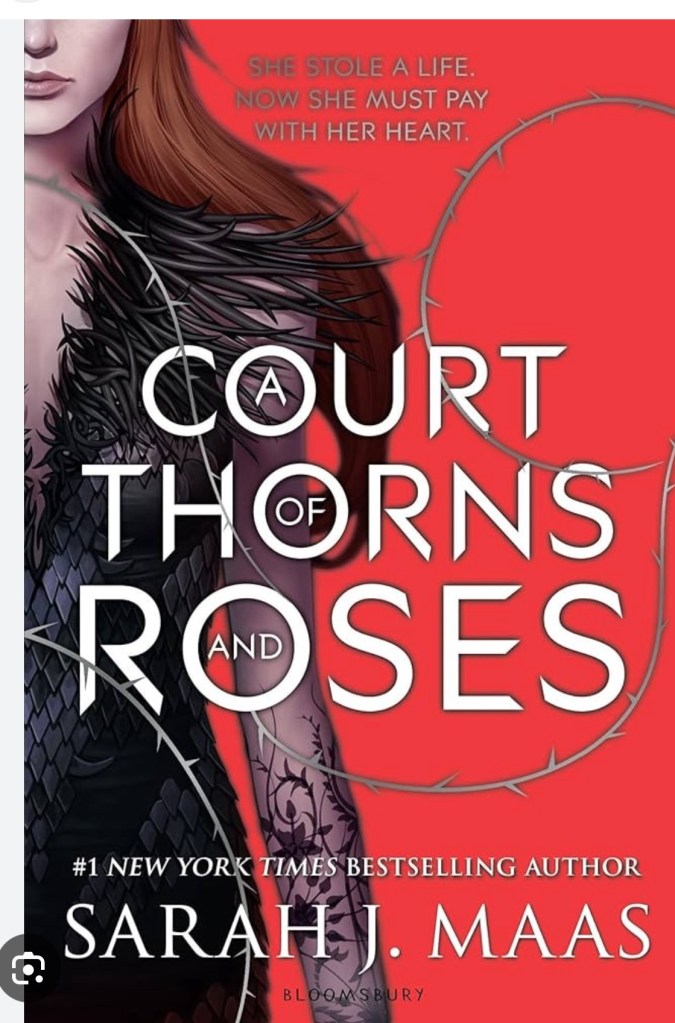
When I first picked up A Court of Thorns and Roses (ACOTAR) by Sarah J. Maas, I had a vague notion of what to expect: a fairytale retelling with a touch of romance, set in a world of fae. Yet, the moment I dove into the pages, I realized that this story was so much more complex, layered, and emotionally charged than I had anticipated. There’s a certain pull that the novel exerts from the very first chapter, a magnetism that comes from both its vivid world-building and its characters, who evolve and deepen in unexpected ways.
The protagonist, Feyre, is immediately captivating. From the start, it’s clear that she is someone forged by hardship. Her life before the events of the book is characterized by poverty, hunger, and survival. Unlike typical fantasy heroines who might already be immersed in magic, Feyre begins as a human hunter in the mortal world, doing what she must to provide for her family. She’s not driven by lofty ideals or aspirations to greatness; she’s simply trying to keep her family alive. This groundedness made her feel real to me, and as someone who appreciates a strong, realistic protagonist, I was instantly drawn to her.
One of the things that impressed me most about A Court of Thorns and Roses is how deftly Maas creates a sense of contrast between Feyre’s bleak, unforgiving mortal world and the lush, magical land of the fae. As Feyre crosses the threshold into this new realm, the descriptions become more vibrant, more fantastical, but always grounded in a sense of danger. The fae in Maas’s world aren’t whimsical or benign creatures—they’re powerful, unpredictable, and often terrifying. Even when the fae lands are beautiful, there’s an underlying sense that everything could turn deadly in an instant. The tension in these scenes is palpable, and I found myself constantly on edge, wondering what might happen next.
At the core of the novel is Feyre’s relationship with these fae creatures, particularly the High Fae. Without revealing too much, I can say that these dynamics are fraught with tension, mistrust, and eventually, a deep complexity that goes beyond the initial “Beauty and the Beast” framework I expected. Maas doesn’t settle for simple relationships or easy resolutions. Instead, she layers her characters with secrets, traumas, and personal stakes that make their interactions feel raw and authentic. Feyre’s emotions are real, whether she’s experiencing fear, anger, or attraction. And the male characters she encounters are far from one-dimensional. Each of them harbors their own motives, which are slowly revealed throughout the story, leaving me questioning who to trust.
What really kept me turning the pages, however, was the evolving nature of Feyre herself. Watching her transformation—both literal and emotional—was one of the most satisfying aspects of the book. She begins as someone primarily concerned with her family’s survival, but as the story progresses, she’s forced to grapple with much larger forces at play. There’s a gradual shift in her priorities, from basic survival to something more profound, and Maas takes her time in allowing this evolution to unfold. Feyre’s growth feels earned, not rushed, and by the time I reached the final third of the novel, I realized I was rooting for her not just because she was the protagonist, but because I had come to care deeply about her journey.
Maas’s world-building is intricate, and she imbues the fae realm with its own history, politics, and social dynamics. The courts of the fae—Spring, Summer, Autumn, and more—each have their own distinct flavor, and while A Court of Thorns and Roses focuses primarily on the Spring Court, Maas hints at the broader world with tantalizing detail. The hierarchy among the fae, the tension between the different courts, and the looming threat of something far darker than Feyre initially realizes all add layers of depth to the story. It’s clear that this is just the beginning of a much larger saga, and while the book does provide a satisfying arc, it leaves enough threads hanging to draw me into the next installment.
I also appreciated the way Maas explores the theme of sacrifice throughout the novel. Feyre is someone who has been sacrificing her own desires and well-being for her family since the very beginning, and as the story progresses, the stakes of what she must give up grow higher. What starts as a simple tale of survival evolves into a narrative about love, duty, and the cost of freedom. The theme of sacrifice isn’t limited to Feyre either; many of the fae characters she encounters have their own burdens to bear, and as the story unfolds, it becomes clear that everyone in this world is grappling with the price of their choices.
The romance in A Court of Thorns and Roses is also worth noting. It’s a slow burn, and while there’s undeniable chemistry between Feyre and a certain fae character, Maas doesn’t rush into it. The relationship is fraught with tension and complexity, and it feels like a natural outgrowth of the characters’ circumstances rather than something shoehorned in for the sake of plot. When the emotional payoff finally arrives, it feels earned. Maas has a talent for writing romance that feels intense without being overdone, and the balance she strikes in this book is particularly well-executed.
One of the things that surprised me most about the novel was its darker elements. The fae world isn’t just dangerous in a physical sense—there’s an emotional and psychological weight to the challenges Feyre faces, and some of the later parts of the book venture into territory that’s much more intense than I expected from the opening chapters. Maas doesn’t shy away from showing the consequences of the characters’ choices, and there are moments of real emotional anguish. At the same time, these darker elements are balanced by moments of beauty and tenderness, which prevent the story from becoming overwhelming.
As I closed the book, I felt a deep sense of satisfaction, but also a hunger for more. A Court of Thorns and Roses is the kind of novel that lingers with you after you’ve finished it. It’s not just because of the cliffhanger (though, yes, Maas does leave you wanting to know what happens next), but because of the emotional journey you’ve gone through with Feyre. Her world, and the characters within it, are so vividly realized that stepping away from them feels like leaving behind something tangible. And that, to me, is the mark of a truly great book.
In short, A Court of Thorns and Roses is a gripping blend of fantasy, romance, and adventure, with a protagonist who is as complex as the world she inhabits. It’s a book that rewards patience, with its slow-building tension, nuanced relationships, and emotional depth. Whether you’re a fan of fairytale retellings or just looking for an immersive, character-driven fantasy, this book is a must-read.


 Chapters on Wheelz
Leave a comment