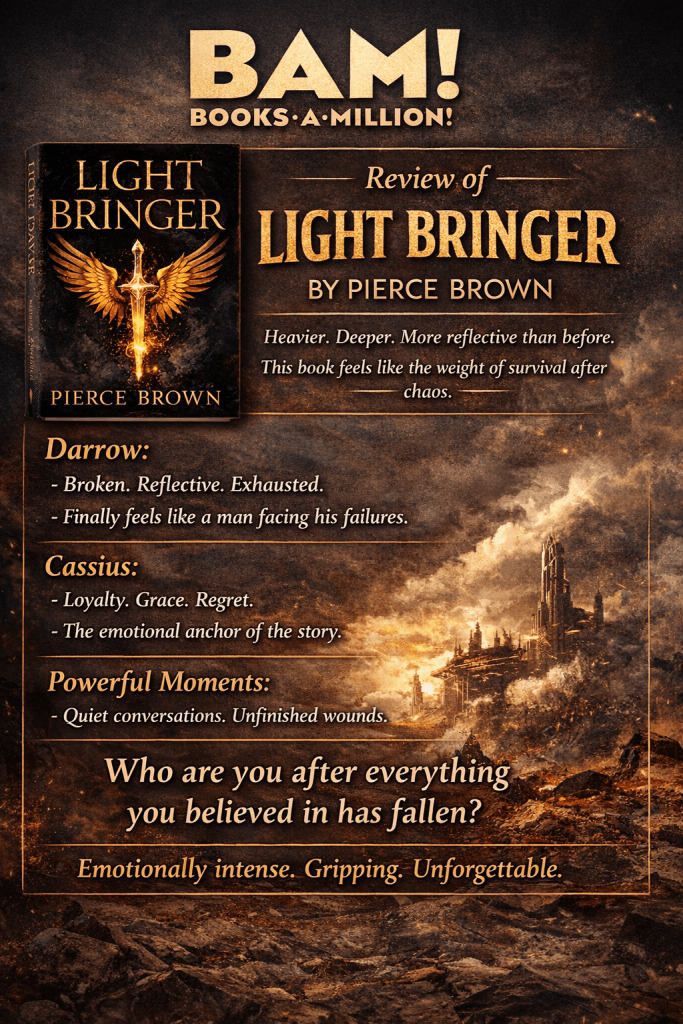
First impression: this book feels heavier than the ones before it
Light Bringer is one of those books that immediately feels different from the moment it starts.
Not because the world has changed — that world is still brutal, political, violent, and constantly unstable — but because the emotional tone has changed.
This book carries exhaustion.
Not boring exhaustion, but the kind where everyone in the story feels like they have already survived too much and now have to somehow keep going anyway.
That changes everything.
Earlier books often ran on adrenaline:
huge battles shocking betrayals sudden violence momentum that barely stopped
But here, Pierce Brown allows space between impact and reaction.
That space matters because it means the emotional consequences finally sit properly.
You are not just watching events happen.
You are watching people carry what those events have done to them.
And that gives Light Bringer a maturity that feels deeper than simple action.
Darrow feels more human here than almost anywhere else in the series
One of the strongest things in the whole book is how Darrow is written.
For a long time, Darrow has often existed as force:
force of will force of rage force of leadership force of myth
In this book, that myth cracks.
And that is exactly why he becomes more compelling.
He is still powerful, still intelligent, still dangerous, but he is no longer moving like someone certain of himself.
He carries hesitation.
Memory.
Regret.
The weight of failure.
That makes every choice feel more meaningful because it no longer feels automatic.
Sometimes in earlier books, Darrow could feel almost too unstoppable, even when suffering.
Here he finally feels like someone who understands what leadership has cost him.
That emotional honesty gives the whole novel depth.
You do not just admire him here.
You understand how tired he is.
And that tiredness is written beautifully.
The emotional writing is stronger than the action writing — and that is saying something
Pierce Brown has always been very good at writing speed.
He knows how to make pages disappear because scenes move fast.
But in Light Bringer, some of the strongest moments are not battles.
They are conversations.
Silences.
Reunions.
Moments where a character says very little but everything underneath it matters.
This book often succeeds because emotion arrives quietly before violence arrives loudly.
That creates stronger impact.
A battle matters more when the emotional fracture underneath it is already there.
And this book understands that.
Cassius becomes one of the most powerful parts of the entire novel
Cassius is written with extraordinary control here.
What makes him so strong is that he brings something rare into this series:
grace.
He has history in every sentence.
Nothing about him feels light or accidental because every conversation carries old wounds underneath.
He also balances Darrow perfectly.
Where Darrow often burns, Cassius steadies.
Where Darrow drives forward, Cassius creates reflection.
And because both characters carry so much shared history, even simple exchanges feel important.
There is warmth in his scenes, but also sadness, because you constantly feel how much has happened between these people before this point.
That gives emotional richness that many action-heavy fantasy books never reach.
The pacing is clever because it knows when not to rush
This is a long book, but it rarely feels wasteful.
That is because Pierce Brown structures momentum carefully.
Large scenes arrive at the right moment, but he also allows breathing room.
That breathing room does two things:
builds emotional attachment prevents the action from becoming numb
Some long fantasy books make the mistake of treating every chapter like climax.
Light Bringer does not.
It understands rhythm.
And because of that, when something major happens, it lands harder.
The dialogue is sharper than before
One thing this book does especially well is dialogue that sounds elevated without sounding artificial.
Many characters speak with intelligence, but not all in the same way.
That matters because in a world like this, voices can easily blur.
Instead:
Darrow sounds burdened Cassius sounds controlled Lysander sounds precise others carry their own political and emotional tone
The dialogue often works because characters rarely say exactly what they feel.
There is always something withheld.
That tension creates strong reading.
Lysander is written in a way that is deeply frustrating — which means he works
Lysander remains one of the most interesting parts of the series because he is not written like a simple villain.
He believes in himself.
That is what makes him dangerous.
He does not move through the book thinking he is cruel.
He moves through it believing he is justified.
That internal certainty creates enormous discomfort because readers can see the gap between his self-image and what he actually becomes.
And Pierce Brown writes that gap very well.
He allows Lysander to sound intelligent enough that you understand why he convinces himself.
But never so convincing that the moral danger disappears.
That balance is difficult to write well.
The world still feels huge without losing emotional focus
A major strength of this series has always been scale:
politics, war, class systems, fleets, alliances, betrayals.
What Light Bringer does especially well is keep that huge scale while narrowing emotional focus enough that you do not feel lost.
You always feel that larger events matter.
But the book never forgets that large events only matter because specific people are carrying them.
That is where many epic science fantasy books fail.
This one usually succeeds.
The prose feels more mature than earlier books
Pierce Brown’s earlier books often leaned heavily into sharp dramatic force.
This one still has that, but there is more restraint.
Some lines hit harder because they are simpler.
He trusts quieter language more now.
That creates moments that stay with you longer because they are not trying too hard to sound unforgettable.
They simply are.
And often those become the lines you remember most.
Why the book feels emotionally heavier than Dark Age in a different way
Dark Age is brutal because everything collapses.
Light Bringer is heavy because everyone must keep living after collapse.
That is a different emotional pain.
This book asks:
what does survival actually look like after devastation?
And often the answer is:
messy
uncertain
unfinished
That realism gives it unusual emotional power.
What makes this book stand out in the series
It is not the most shocking.
It is not the most relentlessly violent.
It is not the fastest.
But it may be one of the richest emotionally because it understands that after years of war, characters should not still feel untouched internally.
They feel altered here.
That alteration gives the story weight.
Small criticism: sometimes the book knows it is building toward something bigger
There are moments where you can feel the next book standing behind this one.
Some sections clearly position future consequences rather than fully resolving current tension.
That is not necessarily bad, but it can occasionally make a section feel like preparation rather than payoff.
Still, because the character writing is strong, that rarely damages enjoyment.
Final feeling after finishing it
The strongest thing Light Bringer leaves behind is not shock.
It is emotional afterweight.
You finish it and feel like the characters have moved through something deeply personal, even when galaxies are involved.
That is difficult to achieve in epic science fiction.
And it is why this book stays with people.
My honest overall view:
It feels like a book about burden, loyalty, identity, and what remains when heroism becomes difficult.
Not just a war book.
Not just a political book.
A book about people trying to carry history without being crushed by it.
⭐ A very strong, emotionally intelligent entry in the series.


 Chapters on Wheelz
Leave a comment