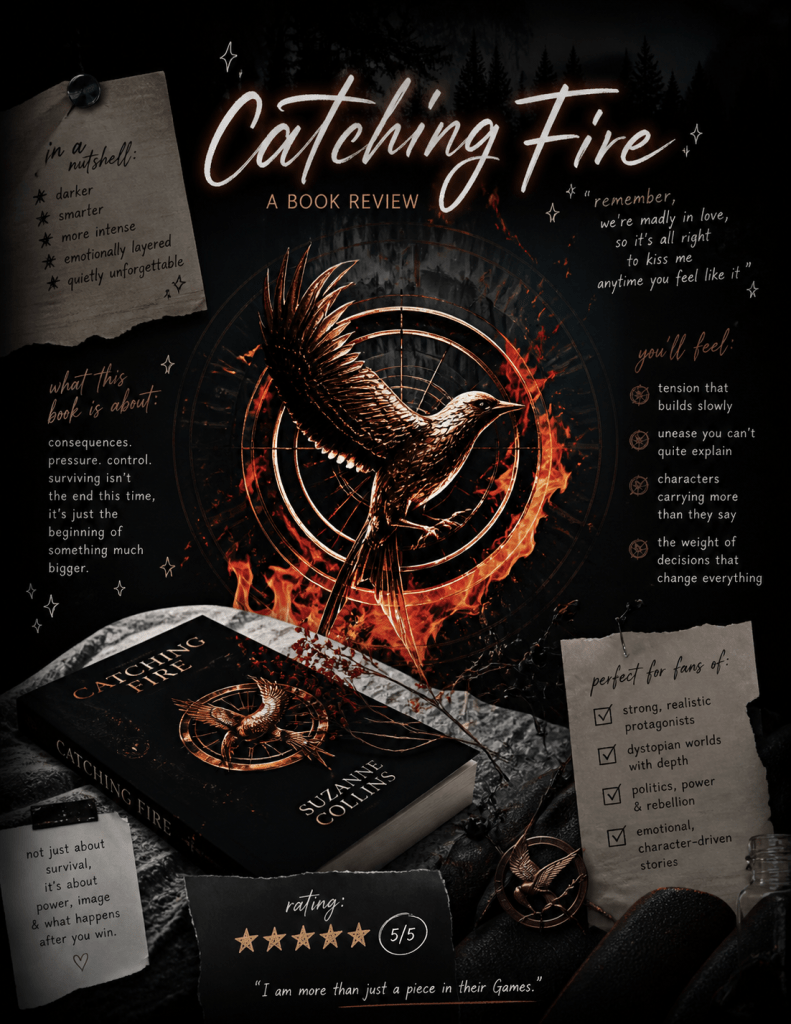
Catching Fire by Suzanne Collins is one of those sequels that quietly upgrades everything without trying too hard. It doesn’t scream “look how intense I am”—it just is.
🧠 The vibe: less action, more pressure
If the first book felt like a survival game, this one feels like:
you survived… now what?
The story leans heavily into:
- consequences
- public image vs private fear
- control, power, and being watched
It’s less about running for your life every second and more about that constant, creeping feeling that something isn’t right.
And weirdly? That makes it more gripping.
🏹 Katniss as a narrator: messy, human, believable
What makes this book work is how grounded it feels.
Katniss isn’t suddenly brave and confident because she survived once. If anything:
- she overthinks more
- trusts less
- and feels the weight of everything
Her internal voice carries the whole book. It’s not poetic or dramatic—it’s practical, blunt, and sometimes conflicted in a way that feels very real.
You don’t just watch the story—you sit inside her decisions, even when they’re frustrating.
🔥 Pacing: slow burn… then it grabs you
Let’s be real for a second:
The start is slower than book one.
But it’s doing important work:
- building tension
- setting stakes
- quietly shifting the tone
Then at a certain point (no spoilers, promise), the book flips a switch and suddenly:
you’re locked in, emotionally invested, and not putting it down.
🎭 Themes: this is where it levels up
This isn’t just a dystopian adventure anymore.
It digs into:
- how power controls people
- how fear is used strategically
- what it means to perform a version of yourself to survive
There’s also a strong thread of:
what happens after the “happy ending” you thought you wanted
And honestly, that’s what makes it stick with you.
💔 Emotional impact: subtle but heavy
This book doesn’t rely on constant shock—it builds emotional weight gradually.
You’ll feel:
- tension that doesn’t quite go away
- moments of unease you can’t explain
- characters carrying more than they say out loud
It’s less dramatic crying, more:
“why do I feel stressed and I’m just sitting here reading??”
⚖️ The honest downsides
Keeping it real:
- The opening can feel a bit slow if you’re expecting instant action
- The main character’s indecision might test your patience at times
- It’s heavier in tone—less “fun survival,” more “oh this is getting serious”
But none of that feels accidental—it’s all part of the shift in story.
🏁 Final verdict (straight to the point)
Catching Fire is:
- smarter than the first book
- more emotionally layered
- and quietly more intense
It trades some fast-paced action for depth and tension, and it absolutely works.
Rating: ⭐⭐⭐⭐⭐ (yes, a full 5 — it earns it)


Leave a Reply