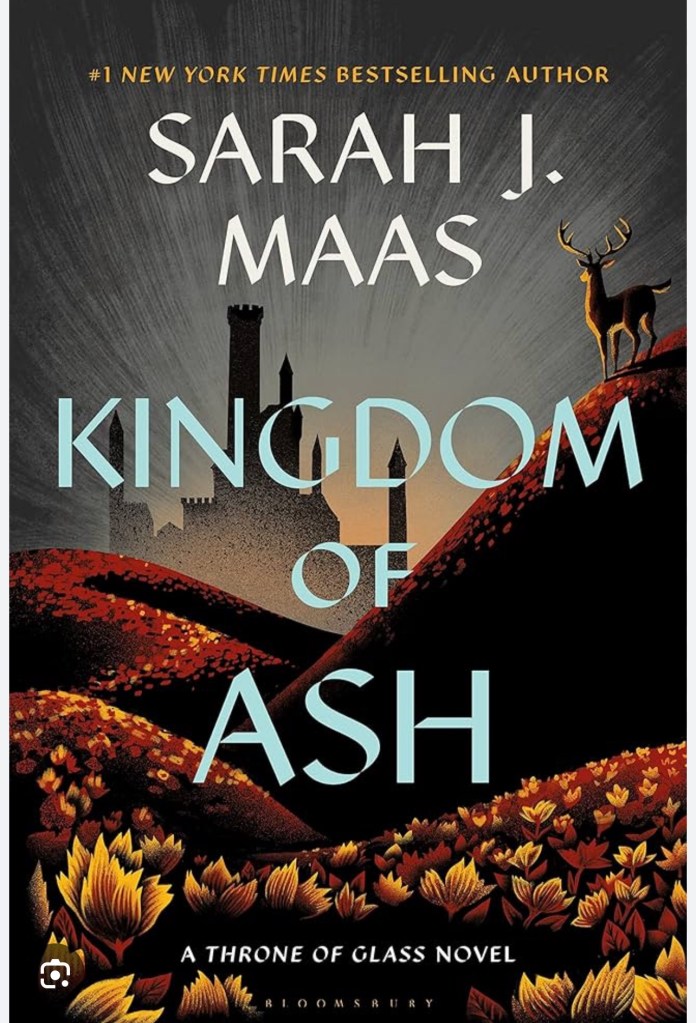
I’ve just finished reading Kingdom of Ash, the final book in Sarah J. Maas’ Throne of Glass series, and I’m feeling a mix of emotions—exhausted from the intensity of it, yet strangely satisfied. This book is the culmination of a journey that started with Throne of Glass and spanned across seven books, growing more complex, darker, and more emotionally charged with each installment. From the very first page, I was reminded of why I fell in love with this series, and by the end, I was left in awe of Maas’ ability to bring such an epic tale to a fitting close.
One of the most striking aspects of Kingdom of Ash is its sheer scope. This is a massive novel in every sense, both physically (nearly 1,000 pages) and in terms of the scale of the story. From the outset, Maas makes it clear that this is going to be an all-encompassing, world-altering conclusion. There are battles, betrayals, and shifting alliances at every turn. What I appreciated most, though, was that none of this grandiosity felt superficial. Every battle, every strategic decision, felt earned and deeply rooted in the characters’ journeys over the series. Nothing is wasted or thrown in for spectacle; everything serves the larger story, and the stakes feel enormous because Maas has spent seven books making me care so deeply about these characters and their world.
Speaking of characters, Kingdom of Ash is absolutely brimming with them. It can be overwhelming at first, trying to keep track of where everyone is and what they’re doing, but Maas weaves together their arcs with such finesse that it never feels confusing or cluttered. There’s Aelin, of course, who has been at the heart of this series since the beginning. In this book, her journey takes on a new level of gravitas. Aelin has always been a complex character—cocky and brash, but also deeply loyal and capable of immense sacrifice. In Kingdom of Ash, she is pushed to her absolute limits, physically, emotionally, and mentally. Her resilience is breathtaking, but what struck me most was how Maas shows her vulnerability. Aelin is a queen, a warrior, and a legend, but she’s also a human being who has suffered incredible trauma, and Maas doesn’t shy away from exploring the emotional toll that takes on her.
Beyond Aelin, there’s a huge supporting cast, all of whom have their own moments to shine. I won’t spoil anything, but there were a few character arcs in particular that absolutely wrecked me. Maas has always been good at crafting multi-dimensional characters, and in Kingdom of Ash, she gives many of them the space to grow and evolve in ways that feel natural and deeply satisfying. I was especially moved by how Maas handled some of the secondary characters who, in lesser hands, might have been overshadowed by Aelin’s larger-than-life presence. Here, they feel just as important to the story and are given their own moments of triumph, heartbreak, and resolution.
One thing I’ve always admired about Maas is her ability to write truly epic, cinematic action scenes, and Kingdom of Ash is packed with them. From large-scale battles to more intimate, one-on-one confrontations, the action is visceral and often brutal. The pacing is relentless, but Maas knows when to pull back and give the characters—and the readers—a moment to breathe. What’s more, these action scenes are never just about spectacle; they’re always grounded in the emotional stakes of the story. Every fight, every sacrifice, feels deeply personal because it’s tied to the characters’ internal journeys.
But while Kingdom of Ash is undeniably action-packed, it’s also a deeply emotional book. There were moments when I had to put it down because I was overwhelmed by the sheer intensity of what the characters were going through. Maas doesn’t pull any punches—there are moments of deep sorrow and loss, but also moments of hope and triumph that had me literally cheering out loud. What I found especially powerful was how Maas balances the darker, more harrowing moments with the idea of hope. Even when things seem impossibly bleak, there’s always a sense that light can be found, and that’s a message that resonated deeply with me.
Another aspect of the book that stood out to me was the way Maas handles the themes of sacrifice, duty, and destiny. Throughout the series, these themes have been woven into the characters’ arcs, but in Kingdom of Ash, they take on new significance. Many of the characters are faced with impossible choices, and the weight of those decisions is palpable. What I loved was how Maas doesn’t offer easy answers. The characters’ sacrifices are real, and the consequences of their actions are felt deeply. But at the same time, there’s a sense of agency—these characters aren’t just being swept along by fate; they’re making choices, and those choices matter.
The world-building in Kingdom of Ash is another highlight. Over the course of the series, Maas has expanded the world of Erilea in fascinating ways, and in this final installment, she brings all the threads together in a way that feels both epic and intimate. The world is vast, with different kingdoms, magical systems, and histories, but Maas never lets the world-building overshadow the characters or the story. Instead, it serves as a rich backdrop that enhances the emotional and thematic depth of the book. I was particularly impressed by how Maas uses the setting to reinforce the themes of the story—whether it’s the desolate, war-torn landscapes that mirror the characters’ emotional states or the lush, magical realms that offer a glimmer of hope in dark times.
If I had any criticism of Kingdom of Ash, it would be that, at times, the pacing can feel uneven. There are moments when the book slows down, particularly in the middle, and I found myself wishing the story would move forward a bit more quickly. But these slower moments are often necessary for character development and emotional reflection, so while they may drag a bit, they ultimately serve the larger narrative.
In the end, Kingdom of Ash is a triumphant conclusion to the Throne of Glass series. It’s a book that’s both epic in scope and deeply personal in its emotional stakes. Sarah J. Maas has crafted a world and characters that will stay with me long after I’ve turned the last page. It’s not an easy read—there are moments of heartache and despair—but it’s also a story of hope, resilience, and the power of choice. I couldn’t have asked for a more fitting end to this incredible series.


 Chapters on Wheelz
Leave a comment